What is the difference between a septic system and a city sewer line for drain problems?
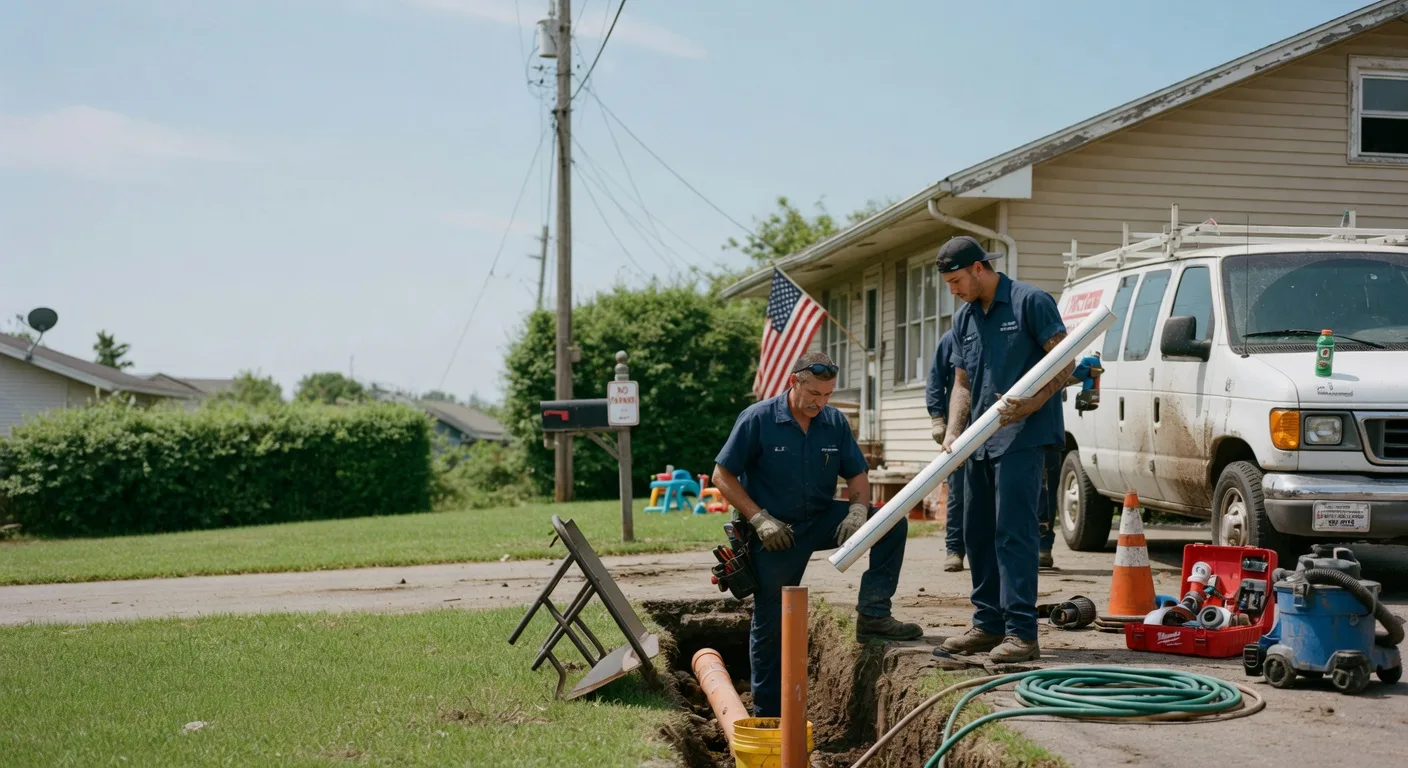
The two systems fail in different places, so the first job is knowing which one your home has. A city sewer line carries wastewater from your house to a municipal main, so trouble is usually confined to the pipe: roots at a clay joint, a bellied section, scale in old cast iron, or a blockage in the lateral. Every drain in the house backing up at once typically means the private line or the connection at the street. A septic system adds a buried tank and a drain field. Solids settle in the tank, and liquid flows out through perforated pipe into the soil. Slow drains or backups can mean a tank that is full and overdue for pumping, a clogged outlet filter or baffle, a failing drain field that can no longer absorb water, or a blockage in the short line between the house and the tank. Soggy ground or a strong odor over the tank area points away from the house plumbing. A cable machine or hydro jetting can clear the house line on either system, but jetting into a septic line needs care about where the water and debris end up. Property paperwork, a cleanout location, or the water utility can tell you which system you have. Expert Plumbers Co connects homeowners with an independent local plumber who works on that type of system.
Homeowners often assume a septic problem and a city sewer problem look the same from the bathroom, but there are a few quick clues. On city sewer, a backup after heavy use is usually the private line or the lateral at the street, and neighbors on the same main may have had the same trouble. On septic, the problem tends to build slowly: drains slow down across the house, the toilet flushes weakly, and a patch of lawn stays wet or unusually green. A common mistake is pouring additives into a septic tank hoping to fix a failing drain field. They do not repair soil that has stopped absorbing water. When you call, tell the plumber how old the system is, when the tank was last opened, and where the cleanout or lid sits. In older homes the tank may be buried deeper than expected and need to be located first, which adds time before any repair starts.
My shower drains slowly. What should I check before calling?
A shower that drains slowly is usually a single fixture problem, and that matters. Hair and soap scum catch in the strainer and the trap just below it. That is a different job from a main line problem, where every drain in the house runs slow.
Safe checks you can do yourself: lift the strainer or stopper and clear what is sitting on it. A plastic drain strip, the kind with small barbs, pulls hair out of the first few inches of pipe. Flush with hot tap water afterwards. Then test the others. Run the bathroom sink and flush the toilet while watching the tub. If water rises or bubbles in the tub, the problem is past this fixture.
Chemical drain openers are best avoided. They sit in a standing pipe, can damage fittings, and are a hazard to whoever opens the line next.
Stop running water and call if the toilet gurgles when the shower empties, if there is a sewage smell, or if water comes up in any drain. Gurgling can point to a blocked vent stack, and slow drains everywhere can point to the main line.
A cable machine is usually enough for hair and soap in a branch line. If it keeps coming back, a camera inspection shows why. Expert Plumbers Co is a referral service, not a plumbing company. We refer you to a local plumber for Drain Cleaning in London, AR: (380) 262-9173.
One more thing to check is whether the problem is the shower drain itself or the pipe it sits in. If the strainer is clear and the water still pools, try removing the cover and looking at how the drain body is built. Some tubs have a pop-up stopper or a trip lever linked through the overflow, and a bent or hair-wrapped linkage can hold the plug partly shut. In older homes the tub may use a lead or cast iron trap further down that fills with soap and hair, while newer showers have a plastic P-trap that is easier to reach from below. A common mistake is pouring boiling water down the drain, which can soften plastic fittings and loosen joints. If the water level drops only after a long wait, even once the strainer is clean, the blockage is deeper in the branch and needs a plumber's tools.
Why did the clog come back worse after I used a store-bought drain snake?
You ran a snake from the hardware store, the water moved for a day, and now the sink is worse than before. That is common, and it comes down to the tool.
A thin hand-crank snake often punches a small hole through the middle of a clog. Water trickles through, so it seems fixed. The clog is still there, and it gets packed tighter as new debris catches on it. Sometimes the snake pushes the clog deeper into a bend, where it is harder to reach. A snake also does not scrape the pipe wall, so the grease build-up stays and the clog forms again quickly.
It is the wrong tool for roots, a bellied line holding water, or scale in cast iron. Those need a heavier cable with a cutting head, hydro jetting, or a camera inspection to see what is actually in the pipe.
Safe homeowner check: place a bucket under the trap, remove it and clear it by hand. Do not add chemical cleaners after snaking, because the plumber may then be working in caustic water.
Stop running water and call if the snake stuck or will not come back out, if other drains gurgle or back up, or if you smell sewage. That points past a single fixture to the main line.
Cost depends on access, what is found, and how much has to be opened up. Expert Plumbers Co is a referral service. Call (380) 262-9173 for Drain Cleaning help from a plumber serving London, AR.
After a failed snake attempt, leave the fixture alone and tell the plumber exactly what you did: the type of snake, how far it went in, whether it hung up, and whether you used any chemical cleaner first. That saves time on site and tells them whether the cable is still stuck or the clog was pushed into a bend. Do not keep running the snake in the hope that it will break through. Forcing a thin cable through a trap or a sharp bend can scratch the pipe wall or damage the trap, and in old cast iron it can knock loose scale that adds to the blockage. Also stop using the sink for a few hours if you can, because the extra water tends to carry loose debris deeper. Expect the proper clearing to include a look at the pipe wall afterwards, so you know whether this was a one-off blockage or a pipe that keeps catching debris.
We are buying a house. Is a sewer camera inspection before closing worth it, and what does it find in older homes?
A standard home inspection covers what can be seen and reached. It does not follow the main drain out under the yard, and that buried pipe is where the expensive surprises sit. On an older house, a camera inspection of the sewer line before closing is usually worth doing.
A plumber feeds a small waterproof camera down the line, normally through a cleanout, and watches the pipe on a screen. The run goes from the house toward the street connection, and the plumber notes how far along each problem sits.
Here is what tends to turn up in older homes:
Tree roots in clay or concrete pipe, entering at joints. They look like fine hair or a thick mat.
Cast iron that has scaled up inside, narrowing the bore, or has cracked along the bottom.
Fiber pipe made of tar and wood pulp, which can go oval and collapse over time.
A bellied section, where the pipe has sagged and holds a pool of water.
Offset or separated joints where the soil has moved, and old broken sections from past digging.
Ask for the video or screenshots, and for the distance of each defect from the cleanout. That gives you something concrete to show your agent and the seller. A root problem that a cable machine or hydro jetting can clear is a very different matter from a collapsed section that needs digging or a trenchless liner. What a repair costs depends on depth, access, how much yard, driveway or slab has to be opened, the materials, and local permit rules. Those are the things to ask a plumber about once the footage is in hand.
Two practical points. First, find out whether the cleanout is reachable, and tell the seller you need access during your inspection window. Second, a camera cannot see through a line that is full of water or packed solid, so the plumber may need to clear it first. If the seller says the line has never given trouble, that is useful, but it does not show the condition of the pipe.
Ask also whether the lateral is shared with a neighbor, since that changes who deals with a defect.
Expert Plumbers Co can connect you with an independent plumber in London, AR for this: call (380) 262-9173.
My sink gurgles after it drains and someone mentioned an air admittance valve. What is that, and can it fail?
"My sink gurgles after it drains" is one of the most common things people notice before a drain problem gets worse. Every fixture needs a vent so water leaving the trap does not pull a vacuum. When air cannot get in, it gets dragged through the trap water instead, and that is the gurgle.
An air admittance valve, or AAV, is a small one-way valve fitted on a vent pipe, often under a sink or in an attic. It opens to let air in as water drains, then drops shut so sewer gas stays in the pipe. Many local codes allow them and some do not, so rules vary by area.
Yes, they can fail. The rubber seal wears, dust or debris stops the flap seating, or the valve sticks. A valve that will not open brings back the gurgling and slow draining. One that will not close lets a sewer smell into the cabinet or room.
A blocked vent stack on the roof, a partial clog in the drain, or a bellied line holding water can also cause gurgling. One gurgling fixture usually points to its own trap, branch line or vent. If the tub, toilet and floor drain all gurgle together, or the toilet bubbles when the washer empties, suspect the main line or the main vent.
Safe homeowner check: Run just the gurgling sink and listen, then run another fixture and see if it does the same. Do not pry at vent parts inside walls, and do not pour drain chemicals into a line that is already gurgling.
Stop running water and call now if sewage smell is strong, water comes up in a tub, shower or floor drain when you use another fixture, a toilet bubbles or rises, or any fixture stops draining.
A cable machine is usually enough for a clog in a single branch line, like the pipe behind one sink. If the gurgle returns, or several fixtures are affected, the plumber may want a camera inspection to look for root intrusion at a clay joint, a bellied line, or a failing section. A blocked roof vent is cleared from the roof, not with a drain cable.
Expert Plumbers Co is a referral service. We connect you with an independent local plumber in London, AR. Call (380) 262-9173.
Ask the plumber whether an AAV is permitted where you live, or whether a conventional vent is needed instead. Cost depends on access to the pipe, the parts or materials needed, how much wall or ceiling has to be opened, and any permit or code requirement.